
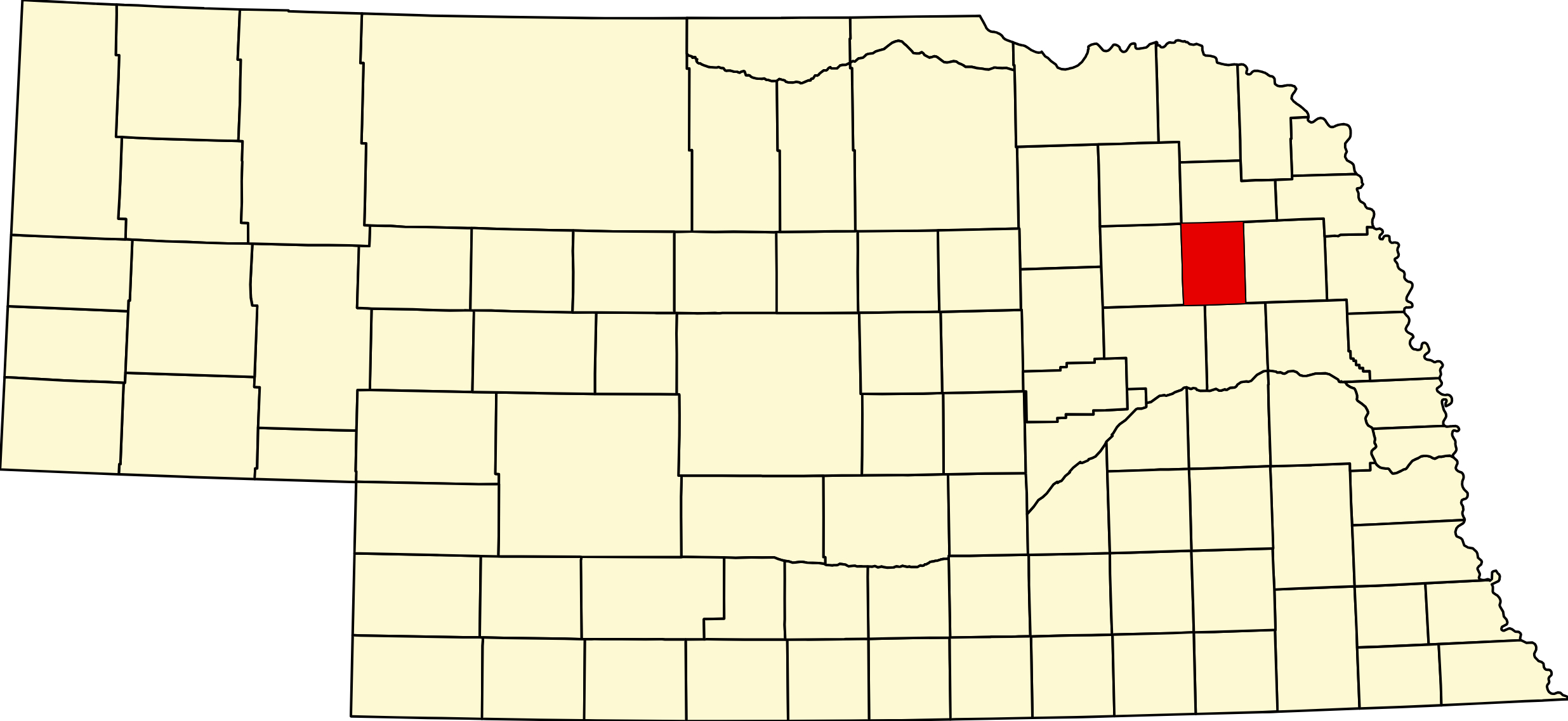
Stanton County, Nebraska
County seat: Stanton · Created: as Izard County, 1855–56; renamed Stanton County 1862; organized January 23, 1867 · Named for: Edwin M. Stanton, Lincoln’s Secretary of War · License plates: prefix 53 · Population: 5,842 (2020 census); about 5,700 (2025); most, 7,809, in 1930 · Area: 431 sq mi (428 land) · Time zone: Central
About Stanton County
Stanton County lies in the Elkhorn River valley of northeast Nebraska, just east of Norfolk, and is part of the Norfolk micropolitan area. Stanton is the county seat and only city, Pilger is the one village, and Woodland Park, 4 miles east-northeast of Norfolk, is an unincorporated community of 1,830, the county’s most populous place. The county borders Wayne on the north, Cuming on the east, Colfax on the south, Platte on the southwest, Madison on the west and Pierce on the northwest.
The territorial legislature created an Izard County in 1855, redrew it in 1856 and renamed it for Edwin M. Stanton in 1862. Charles and Mitchell Sharp took farms in 1865, Germans settled on Humbug Creek in 1866, and the county held its first election that October and was organized on January 23, 1867, with Stanton as its seat; an 1869 vote to move the seat to Clinton was ruled illegal. The railroad came up the Elkhorn from Wisner in 1879–80, and Pilger was platted on it in 1880. On June 16, 2014, twin EF4 tornadoes struck Pilger, killing two people and destroying or badly damaging more than half the village; it has since rebuilt.
Towns of Stanton County
Cities and villages
Stanton
Stanton County seat (1,520) in the Elkhorn valley east of Norfolk, with a 1915 Carnegie library and Maskenthine Lake two miles north.
Pilger
Village of 240 on US 275 and NE 15, struck by twin EF4 tornadoes on June 16, 2014, and rebuilt; “the little town too tough to die.”
Woodland Park
Unincorporated community of 1,830 on NE 35 about 4 miles east-northeast of Norfolk, the most populous place in Stanton County.
Travel Corridors
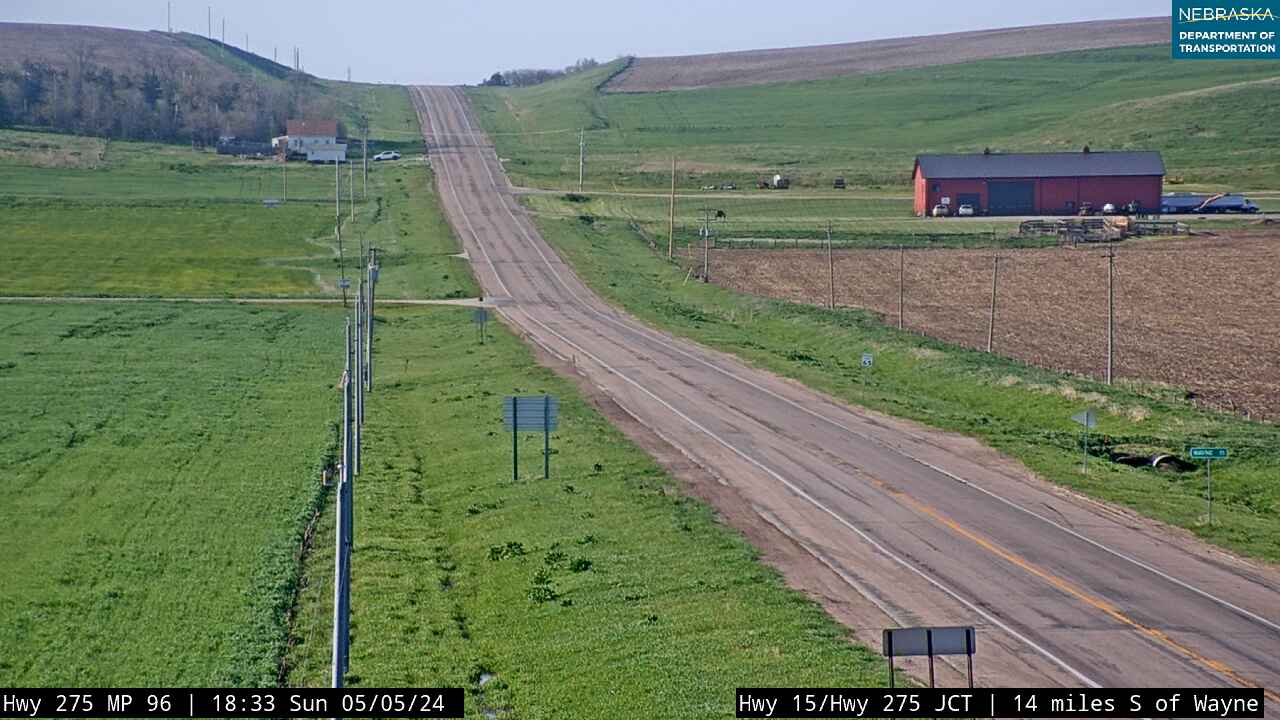
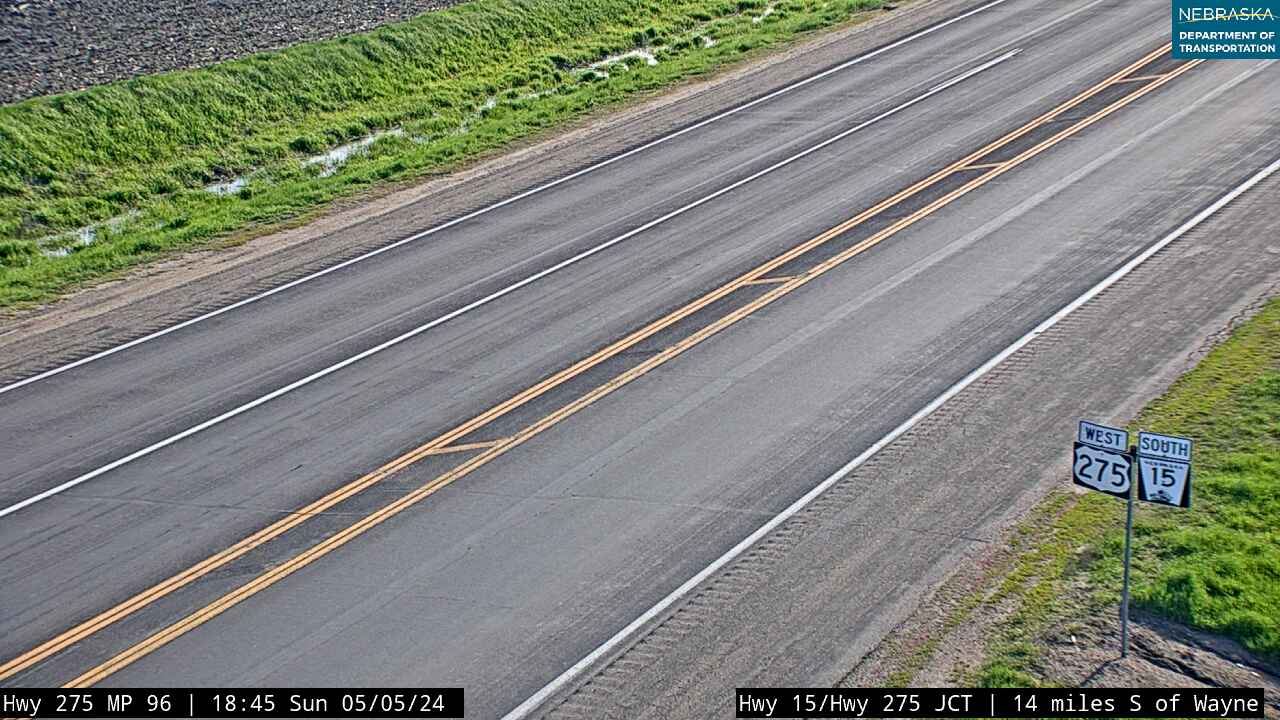
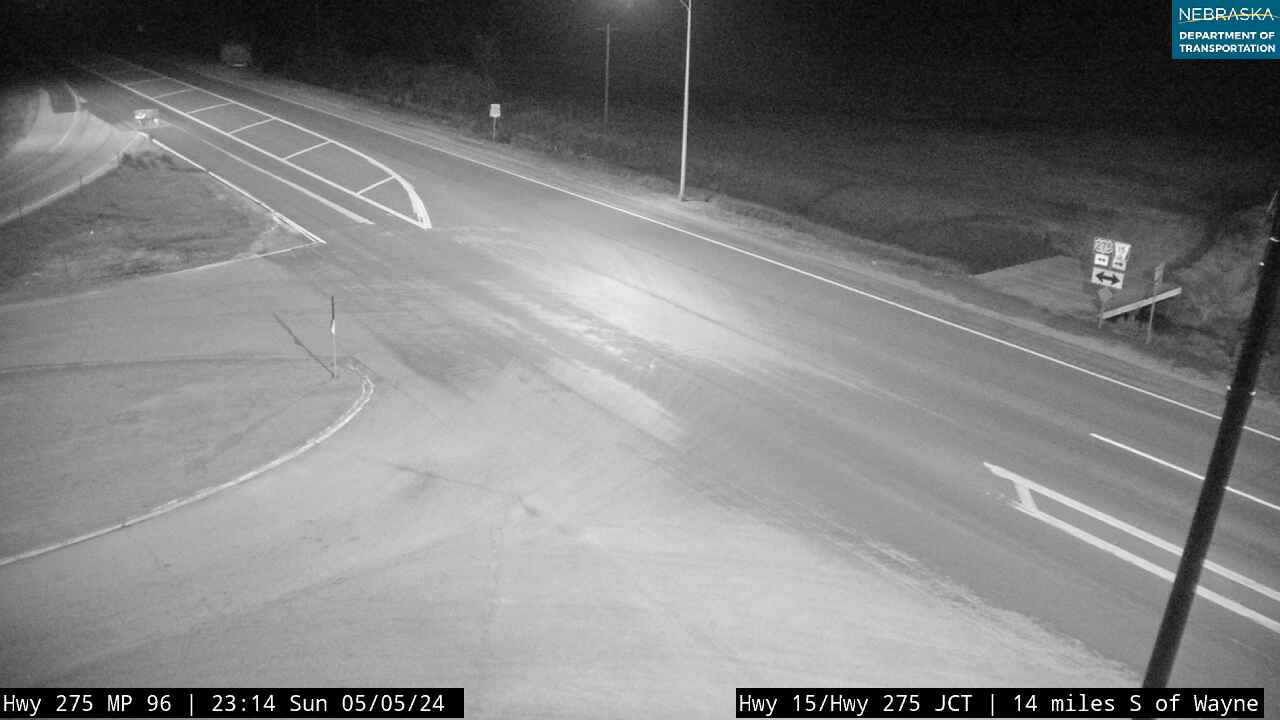
US 275 crosses the north of the county from Wisner through Pilger toward Norfolk. US 275 Corridor → NE 15 runs north–south through Pilger, sharing about 2 miles with US 275, toward Wayne. Highway 15 Corridor → NE 57 runs north–south through Stanton from NE 32 to US 275, NE 24 follows the Elkhorn from Norfolk to Stanton, NE 32 crosses the south of the county, and NE 35 passes through Woodland Park.
Cameras: View Stanton County cameras → · Road conditions: Nebraska 511
Things to See
The county’s one National Register listing is the 1915 Stanton Carnegie Library. Stanton has the Stanton County Heritage Museum, and Pilger the Historical Society of Stanton County and Pilger Museum and a county historical marker on Main Street.
Parks and Outdoors
There is no state park or state recreation area. Maskenthine Lake Recreation Area, 2 miles north of Stanton, is run by the Lower Elkhorn NRD, and the NRD’s Pilger Recreation Area is just north of Pilger. State wildlife management areas are Wood Duck (1,832 acres, southwest of Stanton) and Red Fox (374 acres, south of Pilger). Golf is at Elkhorn Acres near Stanton. There are no motels in the county; the nearest are in Norfolk.
Stanton County Business Directory
Businesses within 20 miles of: Stanton · Pilger · All listings →
Adjacent Counties
Wayne County (north) · Cuming County (east) · Colfax County (south) · Platte County (southwest) · Madison County (west) · Pierce County (northwest).
Events
Pilger Days in early June; Stanton’s Fourth of July fireworks; and the Stanton County Fair in Stanton in late July (July 29–Aug. 2 in 2026).
Events in Stanton County
- Pilger Days (Pilger)
Pilger’s community celebration in early June. - Stanton County Fair (Stanton)
Stanton County Fair, a county fair in Stanton, Nebraska.
Know of another event in the county? Tell us about it.
Stanton County Road Map
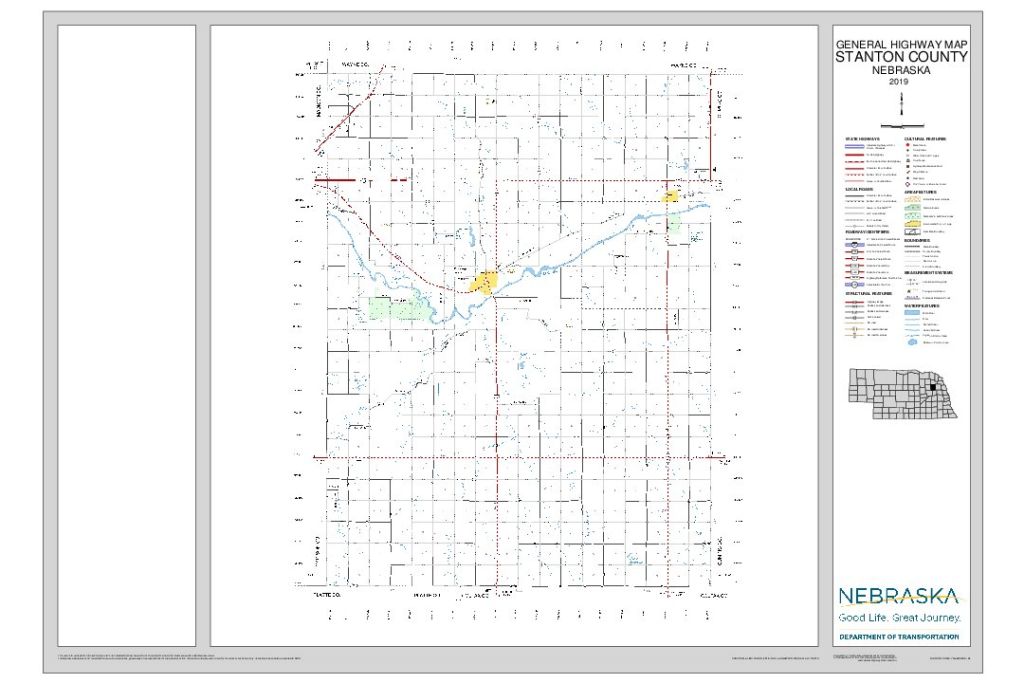
Download the full-size, printable county road map (PDF, Nebraska Dept. of Transportation)

Outdoors: camping, hunting and fishing
Stanton County has no state park or state recreation area. Maskenthine Lake Recreation Area, owned by the Lower Elkhorn NRD, is 2 miles north of Stanton on 839th Road (turn south off 839th between NE 57 and 564th Avenue), about 10 miles east-southeast of Norfolk. Its 100-acre lake (dam built 1976, opened 1979) sits in about 680 acres. There are 33 electric RV pads with fire pits and tables, tent and overflow camping, a seasonal shower house, a swimming beach, a boat ramp (no-wake), Chet’s Pier, a 20-acre arboretum, disc golf, hiking and a mountain-bike trail. No park permit or entry fee. Fees in 2026: $25 a night for an electric pad (20/30/50 amp), $10 per tent and $10 overflow; there is a dump station near the entrance; pads can be reserved up to 60 days ahead from May 1, with a 14-day limit. Fish include northern pike, walleye and channel catfish (stocked), bass, bluegill and crappie. Hunting is allowed except within 200 yards of facilities. Lower Elkhorn NRD (402) 371-7313.
The NRD’s Pilger Recreation Area, 119 acres a mile north and half a mile east of Pilger, was built for flood protection more than 50 years ago; the NRD says many of its former amenities have been removed, so call ahead. State wildlife management areas: Wood Duck, 1,832 acres about 3 miles southwest of Stanton (no target shooting), and Red Fox, 374 acres a mile south of Pilger on NE 15, with a 25-acre sandpit lake, a primitive boat ramp and primitive camping.
Stanton County at a Glance
Stanton County, Nebraska — renamed in 1862 for Lincoln’s Secretary of War and organized in 1867. County seat Stanton. Population 5,842 at the 2020 census. 86 listings across 3 towns.
Getting there: US 275 and NE 15 meet at Pilger; NE 57 and NE 24 serve Stanton; Norfolk is about 12 miles west-northwest of Stanton. Central Time.
For visitors: camping, fishing and trails at Maskenthine Lake north of Stanton, and Pilger, rebuilt after the 2014 tornadoes.
Vehicles registered in Stanton County carry license plate number 53. See what every Nebraska county number means.
Stanton County Businesses & Places
86 listings in Stanton County.
Click a category to see the businesses.
Eat & Drink (2)
- The Greenhorn — Bar & Grill, Nebraska
- The Uptown Brewery — Brewery & Taproom, Nebraska
Outdoors & Recreation (6)
- Elkhorn Acres Golf Course — Golf Course, Nebraska
- Maskenthine Lake Disc Golf Course — Disc Golf Course, Nebraska
- Maskenthine Lake Recreation Area — Campgrounds & RV Parks, Nebraska
- Red Fox WMA — Public Hunting Areas & WMAs, Nebraska
- Village of Pilger Campgrounds — Campgrounds & RV Parks, Nebraska
- Wood Duck WMA — Public Hunting Areas & WMAs, Nebraska
Places to Visit (3)
- Historical Society of Stanton County and Pilger Museum — Specialty Museums, Nebraska
- Pilger Recreation Area — City Parks, Nebraska
- Stanton County Heritage Museum — History & Heritage Museums, Nebraska
Events & Venues (3)
- Pilger Days — Festivals & Celebrations, Nebraska
- Stanton County Fair — County Fair, Nebraska
- Stanton County Fairgrounds — Fairground, Nebraska
Health & Emergency (1)
- Stanton Dental — Dentist & Dental Office, Nebraska
Shopping & Gifts (2)
- K's Marketplace — Grocery, Nebraska
- Windmill Market — Retail, Nebraska
Community & Faith (28)
- Bega Cemetery — Stanton — Cemeteries, Nebraska
- Belz Cemetery — Stanton — Cemeteries, Nebraska
- Bethlehem Cemetery — Stanton — Cemeteries, Nebraska
- Christ Lutheran Cemetery — Woodland Park — Cemeteries, Nebraska
- Elkhorn Cemetery — Pilger — Cemeteries, Nebraska
- Erychleb Cemetery — Stanton — Cemeteries, Nebraska
- Faith Lutheran Church — Lutheran Church, Nebraska
- Hoosier Hollow Pioneer Cemetery — Stanton — Cemeteries, Nebraska
- Koch Cemetery — Stanton — Cemeteries, Nebraska
- Kuehn Cemetery — Pilger — Cemeteries, Nebraska
- Muller Cemetery — Pilger — Cemeteries, Nebraska
- New England Congregational UCC — Stanton — Congregational Church, Nebraska
- Norwegian Cemetery — Stanton — Cemeteries, Nebraska
- Pilger Cemetery — Pilger — Cemeteries, Nebraska
- Saint Henrys Cemetery — Stanton — Cemeteries, Nebraska
- Saint Johns Lutheran German Cemetery — Stanton — Cemeteries, Nebraska
- Schwedt Cemetery — Pilger — Cemeteries, Nebraska
- Spring Branch Cemetery — Stanton — Cemeteries, Nebraska
- St. John Lutheran Church — Lutheran Church, Nebraska
- St. John's Lutheran Church — Lutheran Church, Nebraska
- St. Luke's Lutheran Church — Lutheran Church, Nebraska
- St. Peter Catholic Church Stanton — Catholic Church, Nebraska
- St. Peter's Lutheran Church — Lutheran Church, Nebraska
- Stanton Cemetery — Stanton — Cemeteries, Nebraska
- Stanton EFC — Evangelical Free Church, Nebraska
- Zander Cemetery — Stanton — Cemeteries, Nebraska
- Zilmer Cemetery — Stanton — Cemeteries, Nebraska
- Zion Cemetery — Woodland Park — Cemeteries, Nebraska
Government & Resources (21)
- Pilger Community Food Pantry — Food Pantry, Nebraska
- Pilger Post Office — Post Office, Nebraska
- Pilger Public Library — Libraries, Nebraska
- Pilger Senior Citizens — Senior Citizen Center, Nebraska
- Stanton City Hall — City Hall, Nebraska
- Stanton County Assessor — County Assessor, Nebraska
- Stanton County Attorney's Office — County Attorney, Nebraska
- Stanton County Clerk — County Clerk, Nebraska
- Stanton County Court — County Court, Nebraska
- Stanton County Courthouse — Court House, Nebraska
- Stanton County Emergency Management — Emergency Management, Nebraska
- Stanton County Sheriff — County Sheriff, Nebraska
- Stanton County Treasurer — County Treasurer, Nebraska
- Stanton County Veterans Service Office — Veterans Office, Nebraska
- Stanton County Weed Superintendent — County Weed Control, Nebraska
- Stanton Fire Department — Fire Station, Nebraska
- Stanton Health Center (Nursing Home) — Senior Citizen Center, Nebraska
- Stanton Housing Authority — Housing Authority, Nebraska
- Stanton Post Office — Post Office, Nebraska
- Stanton Public Library — Libraries, Nebraska
- Stanton USDA Service Center — USDA Service Center (FSA/NRCS), Nebraska
Education (5)
- Stanton Community Schools — School District (K-12 / General), Nebraska
- Stanton County Extension — County Extension Office, Nebraska
- Stanton Elementary School — Elementary & Middle School, Nebraska
- Stanton High School — High School, Nebraska
- Woodland Park Elementary School — Elementary & Middle School, Nebraska
Professional Services (4)
- Campbell-Eberly Insurance — Insurance, Nebraska
- First Nebraska Bank — Banking, Nebraska
- Midwest Bank – Pilger — Banking, Nebraska
- Stanton State Bank — Banking, Nebraska
Automotive (4)
- Casey's General Store - Stanton — Casey's, Nebraska
- Kuehn Auto Sales Stanton — Used Car Dealer, Nebraska
- Pilger Store — Fuel & Gas Station, Nebraska
- Spurville Motors — Used Car Dealer, Nebraska
Personal Services (2)
- Minnick Funeral Home — Funeral Home, Nebraska
- Shultz-Vogel-Johnson Mortuary — Funeral Home, Nebraska
Utilities (2)
- Stanton County Public Power District — Electric Power Provider, Nebraska
- Village of Pilger — Water Utility / District, Nebraska
Land & Property Services (1)
- Directional Zone — Land Clearing & Brush Removal, Nebraska
Agriculture & Farm (1)
- Farmers Cooperative – Pilger — Grain Elevator / Cooperative, Nebraska
Media (1)
- Stanton Register — News Paper, Nebraska