Nebraska Highway 14: Kansas to South Dakota
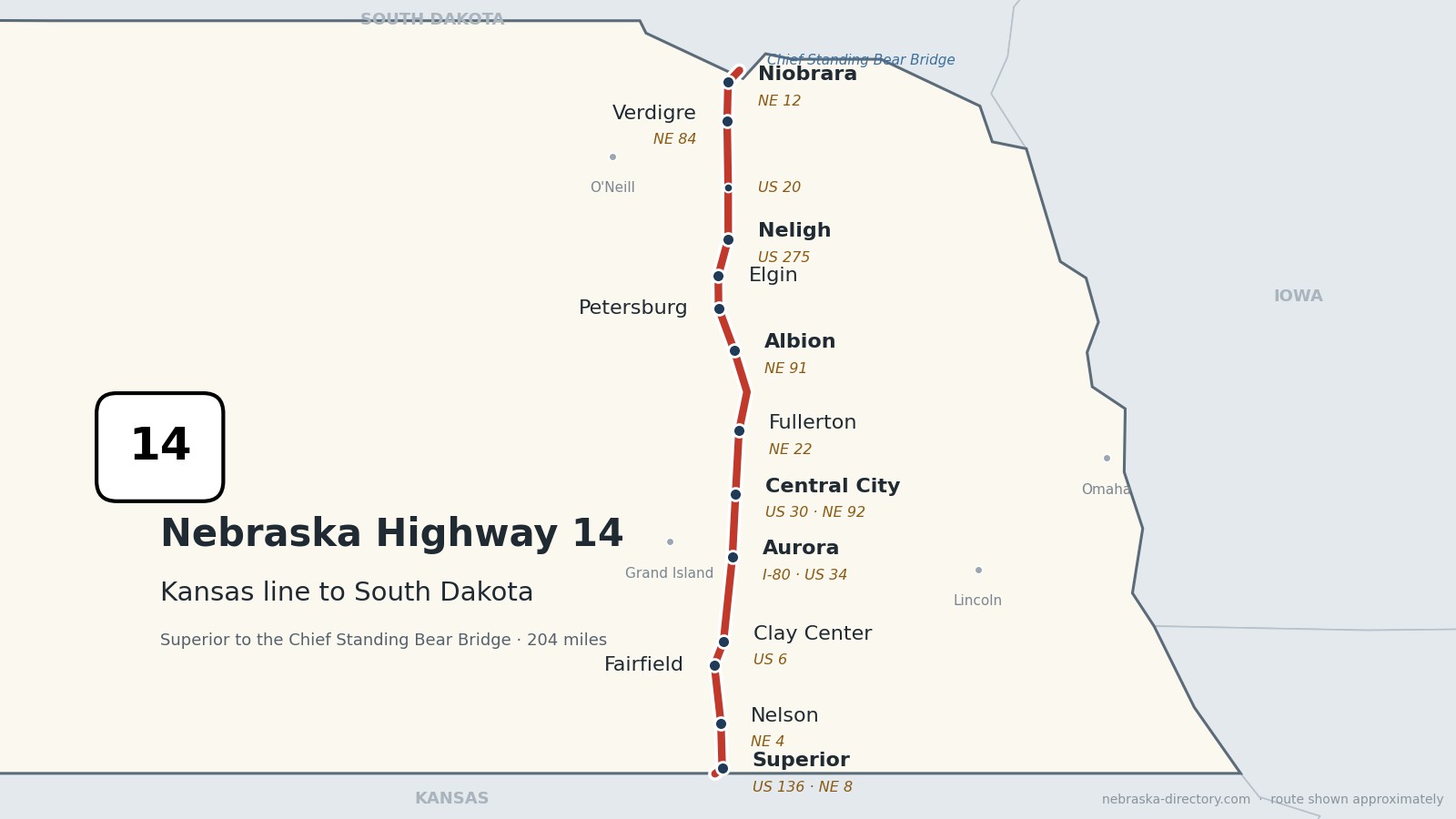
Nebraska Highway 14 runs about 204 miles north from the Kansas line near Superior to the Chief Standing Bear Memorial Bridge over the Missouri River at Niobrara, nearly the full height of the state. It is one continuous road through eight counties and seven county seats: Nelson, Clay Center, Aurora, Central City, Fullerton, Albion and Neligh. It crosses the Platte south of Central City and the Elkhorn at Neligh, crosses Interstate 80 at Aurora, and shares short stretches with US 136, US 6, Nebraska 92, Nebraska 22, Nebraska 91 and Nebraska 12.
Before it was 14.
No named auto trail ran along this line. On the 1924 list of Nebraska's named highways, a Seward–York–Aurora road touched Aurora, and the Grainfield Highway ran east from Central City along the north side of the Platte.
Today's Highway 14 dates from 1925. It first ended at Neligh, and in the middle it took a longer path, east from Fullerton to Genoa and back northwest to Albion, over roads that are now Highways 22 and 39. It was later extended north to Niobrara and ended there for decades. Travelers crossed the Missouri on the Running Water ferry until it stopped in 1984; the Chief Standing Bear Memorial Bridge opened on August 29, 1998, and made Highway 14 a road across the whole state.
The railroads shaped most of the towns. The Union Pacific founded Central City as Lone Tree in 1866, a Chicago & North Western branch created Petersburg in 1887, and Verdigre was platted that same year just ahead of the Fremont, Elkhorn & Missouri Valley. Neligh (1873) and Superior (1875) were platted before their railroads arrived.
Begin your journey at Superior and head north: through the county seats of Nelson, Clay Center and Aurora, across the Platte to Central City, up through Fullerton, Albion and Neligh, and on to Verdigre, Niobrara and the Missouri River.
Counties along Highway 14, south to north: Nuckolls · Clay · Hamilton · Merrick · Nance · Boone · Antelope · Knox
Nuckolls County on Highway 14
Superior and Nelson.
On the road: Superior (US 136, NE 8) · Nelson (NE 4) · Nuckolls County page
Highway 14 enters from Kansas southwest of Superior, where Nebraska 8 begins, then runs with US 136, the Heritage Highway, for about four miles before turning north to Nelson, the county seat, where it shares a mile with Nebraska 4.
History along the road. Superior was platted in 1875 and named, the story goes, for the quality of its land. It calls itself the Victorian Capital of Nebraska, its downtown is on the National Register of Historic Places, and the Santa Fe reached it in 1887; the Nuckolls County Museum is there. Nelson has been the county seat since 1873 and is named for Horatio Nelson Wheeler, who owned the town site; it kept the county seat in an 1889 contest with Superior. Red Cloud, home of the National Willa Cather Center, is about 25 miles west of Superior.
Clay County on Highway 14
Fairfield and Clay Center.
On the road: Fairfield (NE 74) · Clay Center (US 6) · Deweese (spur) · Edgar (spur) · Clay County page
The road passes spurs to Deweese and Edgar, runs a mile with Nebraska 74 at Fairfield, and reaches Clay Center, the county seat, where Nebraska 41 begins. North of town it shares about three miles with US 6.
History along the road. Fairfield began in 1872 as the railroad was built and is the birthplace of Governor Samuel R. McKelvie. Clay Center was laid out in 1879 and named for Henry Clay; the Clay County Museum is there.
Live cameras. Images from Nebraska 511; click one to open it full size.

Hamilton County on Highway 14
Aurora.
On the road: Aurora (I-80, US 34) · Marquette (spur) · Hamilton County page
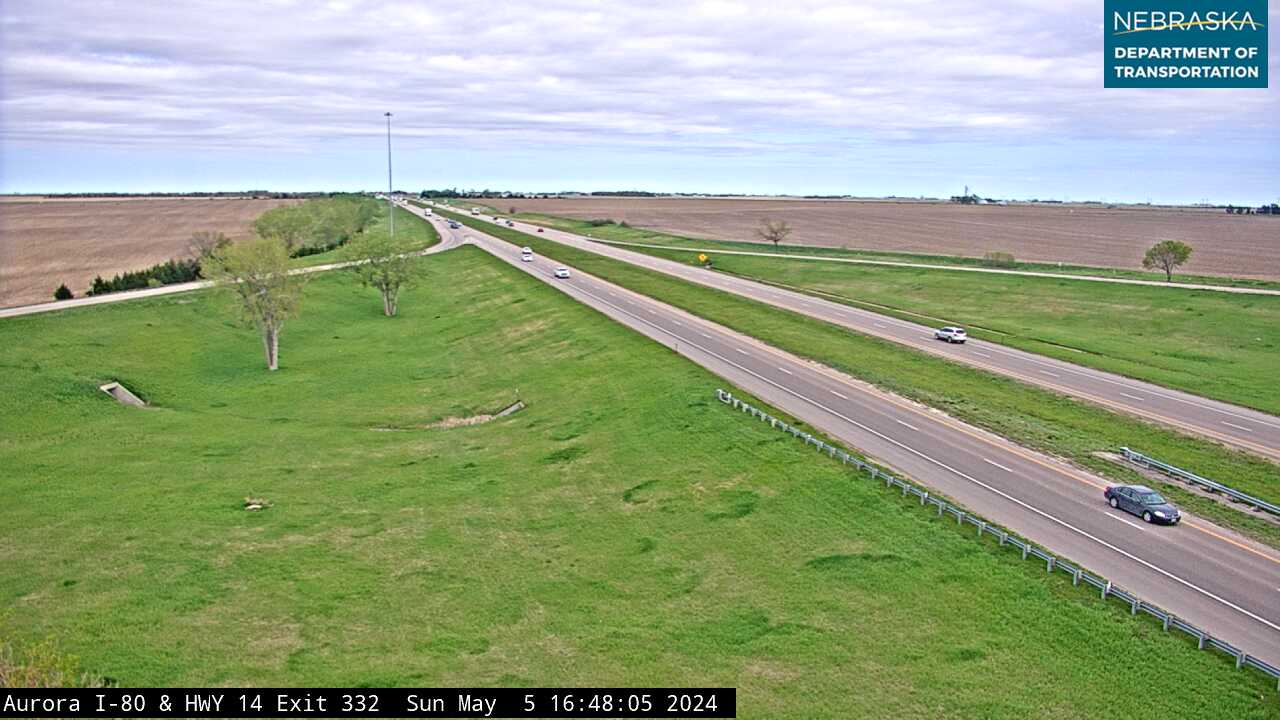
Highway 14 crosses Interstate 80 at exit 332 and runs into Aurora, the county seat, where it crosses US 34. North of town a spur leads to Marquette, and the road crosses the Platte River into Merrick County.
History along the road. Aurora was laid out in 1871 by David Stone, named for Aurora, Illinois, and became the county seat in 1876. It is the birthplace of Harold "Doc" Edgerton, the MIT engineer who developed the strobe light; the Edgerton Explorit Center, a hands-on science center, carries his name, and the Plainsman Museum tells the county's pioneer story.
Live cameras. Images from Nebraska 511; click one to open it full size.
Merrick County on Highway 14
Central City.
On the road: Central City (US 30, NE 92) · Merrick County page
North of the Platte, Highway 14 passes Nebraska 66 and runs into Central City, the county seat, where it crosses US 30 and the Union Pacific main line, then shares a mile with Nebraska 92 north of town.
History along the road. Central City was founded in 1866 as Lone Tree, named for a landmark cottonwood, as the Union Pacific laid its track; it was renamed in 1875. Author Wright Morris lived there as a boy, and the Merrick County Historical Museum is in town. NDOT plans a viaduct to carry Highway 14 over the Union Pacific tracks in Central City; construction could start as early as 2027.
Nance County on Highway 14
Fullerton.
On the road: Fullerton (NE 22) · Genoa (east on NE 22) · Nance County page
The road reaches Fullerton, the county seat, where it shares about a mile and a half with Nebraska 22. Genoa is about 14 miles east.
History along the road. Fullerton was platted about 1878 and named for Randall Fuller. The land around it was part of the Pawnee Reservation until the Pawnee were moved to Indian Territory in the 1870s. Genoa was the reservation's agency town and later the site of a federal Indian industrial school; the Genoa Historical Museum tells that story.
Boone County on Highway 14
Albion and Petersburg.
On the road: Albion (NE 91) · Petersburg · Cedar Rapids and St. Edward (via NE 56) · Boone County page
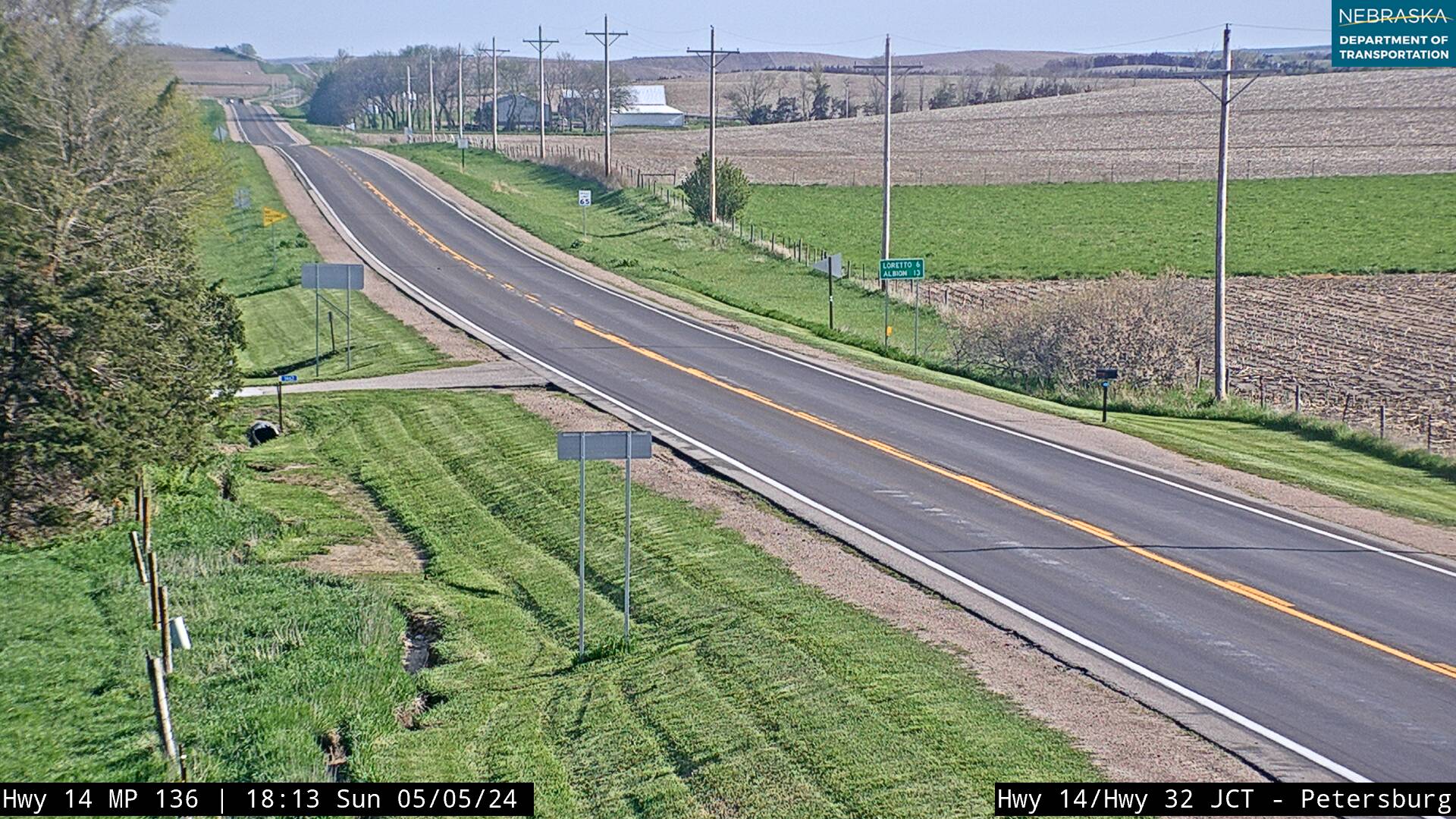
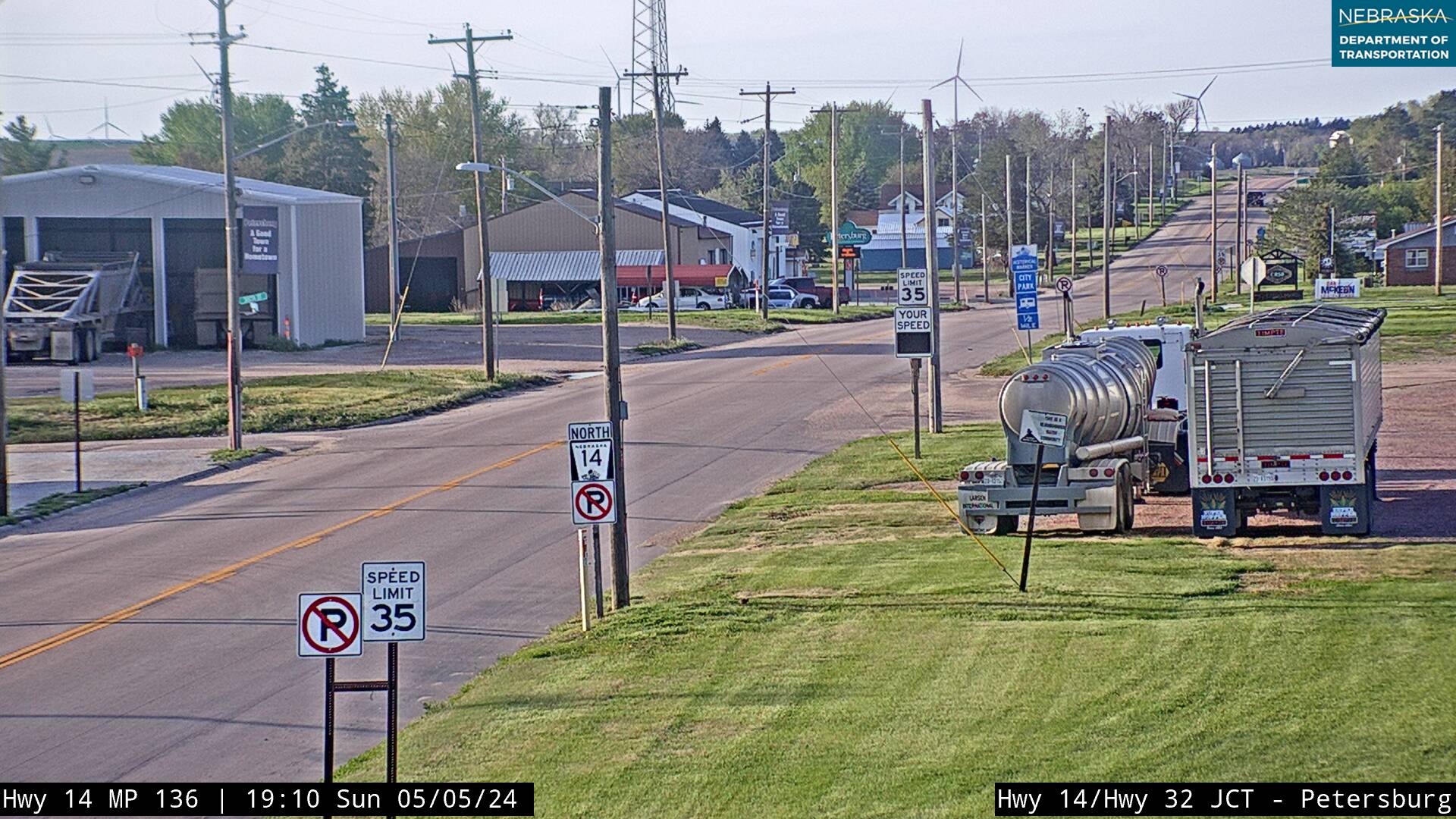
Highway 14 passes Nebraska 52 and Nebraska 56, which lead to Cedar Rapids and St. Edward, runs a few blocks with Nebraska 91 through Albion, the county seat, and continues north to Petersburg, where Nebraska 32 heads east.
History along the road. Albion was platted in 1872 and has been the county seat since 1873; its name, from Albion, Michigan, is said to have been chosen in a game of euchre. Petersburg was platted in 1887, when a Chicago & North Western branch arrived, and named for John Peters. A memorial there honors Omaha chief Logan Fontenelle, who was killed nearby in 1855.
Live cameras. Images from Nebraska 511; click one to open it full size.
Antelope County on Highway 14
Elgin, Neligh and the Elkhorn.
On the road: Elgin · Neligh (US 275) · US 20 (between Royal and Brunswick) · Antelope County page
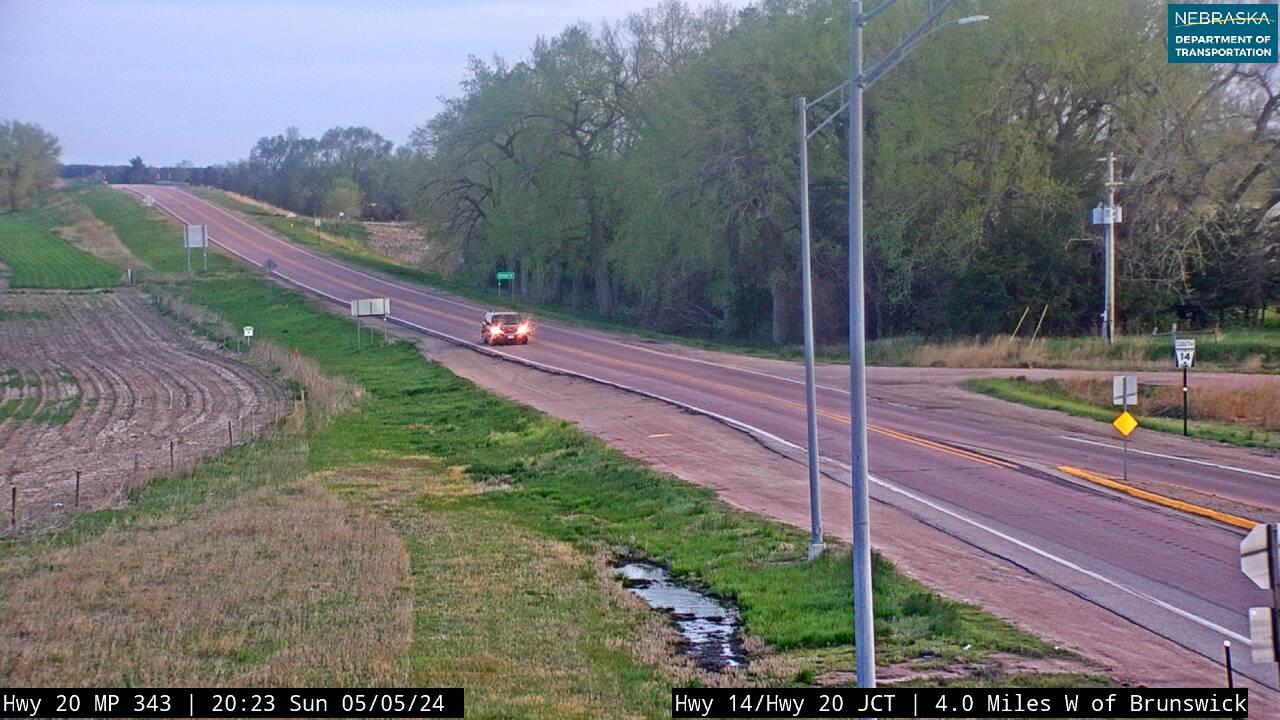
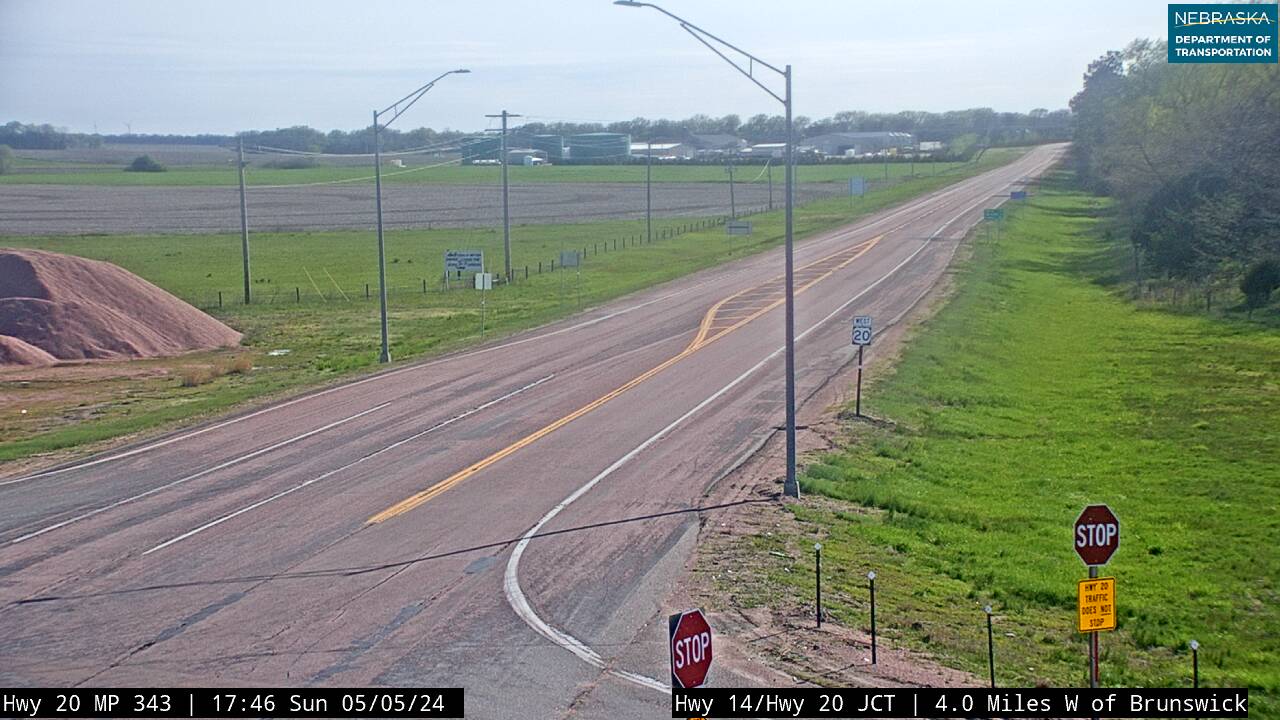
The road runs north to Elgin, where Nebraska 70 heads west, and on to Neligh, the county seat, on the Elkhorn River, where it crosses US 275. North of Neligh it crosses US 20 between Royal and Brunswick. Ashfall Fossil Beds State Historical Park, where volcanic ash buried rhinos, horses and camels about 12 million years ago, is near Royal, roughly 11 miles off Highway 14; it is closed from mid-October through April.
History along the road. Neligh was platted in 1873 by John D. Neligh and won the county seat from Oakdale in 1884. The Neligh Mill, built in 1873 on the Elkhorn, is a state historic site, and the Antelope County Museum is in town. White Buffalo Girl, a Ponca child who died during the tribe's forced removal in 1877, is buried in Neligh's Laurel Hill Cemetery. Elgin was platted in 1887 and named for Elgin, Illinois.
Live cameras. Images from Nebraska 511; click one to open it full size.
Knox County on Highway 14
Verdigre, Niobrara and the Standing Bear bridge.
On the road: Verdigre (NE 84) · Center (east on NE 84) · Niobrara (NE 12) · Niobrara State Park · Knox County page
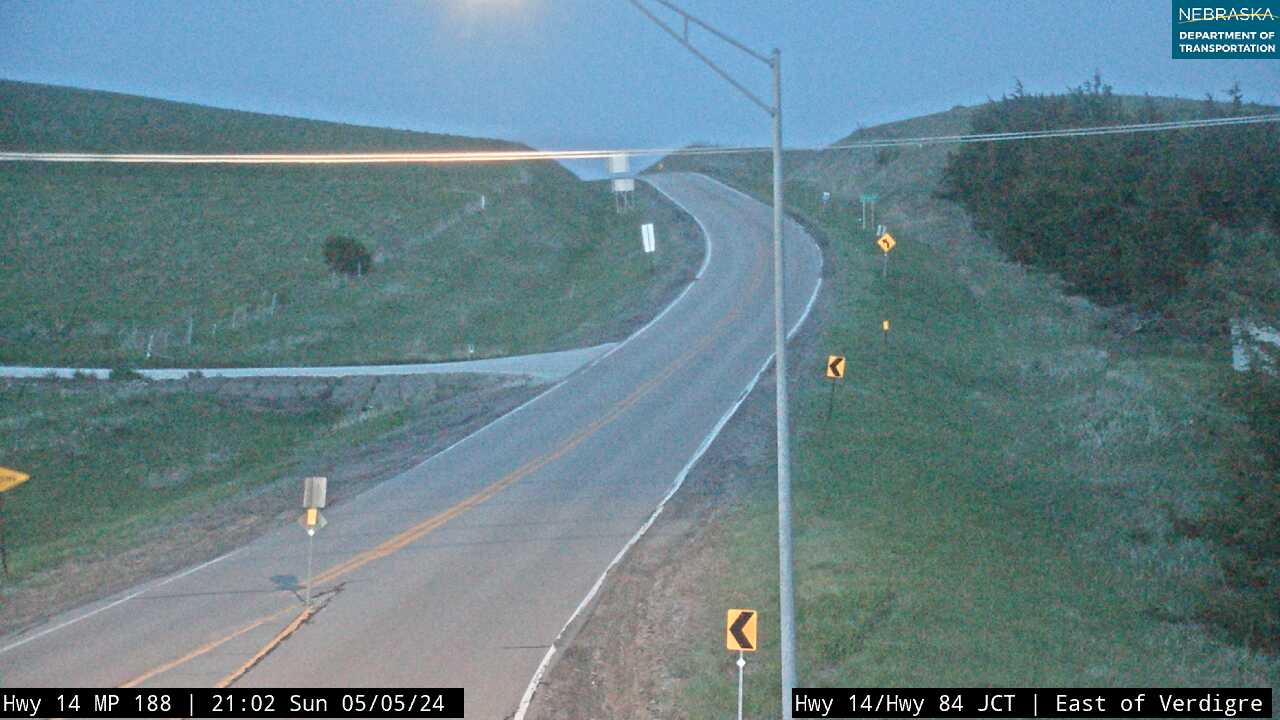
Highway 14 crosses the hills to Verdigre, where Nebraska 84 heads east toward Center, then runs north to the Niobrara River and shares about three miles with Nebraska 12 into Niobrara. Just east of the village it turns north onto the Chief Standing Bear Memorial Bridge, nearly 3,000 feet long, and crosses the Missouri into South Dakota, where it continues as SD 37. Niobrara State Park sits where the Niobrara meets the Missouri.
History along the road. Verdigre was platted in 1887, named for Verdigre Creek, and calls itself the Kolach Capital of the World; Kolach Days is held each June. Niobrara, founded in 1856, has moved twice, after an 1881 flood and again in the 1970s because of rising water behind Gavins Point Dam, and it is headquarters of the Ponca Tribe of Nebraska. The bridge, named for Ponca chief Standing Bear, who was born and buried nearby, cost about $17 million and opened on August 29, 1998.
Live cameras. Images from Nebraska 511; click one to open it full size.
Nebraska Road Conditions & Highway 14 Travel Tips
Highway 14 is two lanes nearly all the way, with towns close together in the south and longer gaps north of Neligh. Check current conditions before you travel, especially in winter.
RV Travel & Camping Along Highway 14
- Niobrara State Park — at Niobrara
Related Nebraska Travel Corridors
- US Highway 136 — at Superior
- Highway 4 — at Nelson
- US Highway 6 — at Clay Center
- Interstate 80 — at Aurora
- US Highway 30 and Highway 92 — at Central City
- Highway 91 — at Albion
- US Highway 275 — at Neligh
- US Highway 20 — north of Neligh
- Highway 84 — at Verdigre
- Highway 12 — at Niobrara
- ← Explore All Nebraska Travel Corridors